 Silk Road Tours
Home › Guides › When Is the Best Time to Visit Uzbekistan for a Silk Road Tour?
When Is the Best Time to Visit Uzbekistan for a Silk Road Tour?
The best time to visit Uzbekistan is March to mid-June and September to October, when days sit between 14°C (57°F) and 30°C (86°F). This guide covers each month, the festivals, the regional extremes, the worst and cheapest months and which Silk Road tours fit each season. July and August push past 40°C (104°F) in Bukhara and the desert. Those months suit only travellers who plan their days around the heat.
Quick answer Best months for a Silk Road tour
Travel between March and mid-June or in September and October, when temperatures hold between 14°C (57°F) and 30°C (86°F). The tourism portal also names spring and autumn as the most comfortable seasons for sightseeing. Desert treks run in both windows. July and August are the hardest months, when Bukhara regularly climbs above 40°C.
Key takeaways
- Compare Silk Road tours in Uzbekistan before you fix a month.
- Read the month-by-month table for the full climate picture.
- Pair a season with a route in the season planner, from the yurt camp to the three cities.
- Skip the heat peak from late June to early August, the worst time for long walks.
What is the best month to visit Uzbekistan?
April and May offer the best comfort and landscape colours, with late September to October close behind at harvest time.
Uzbekistan has an extreme continental climate. Spring and autumn are the windows when walking between madrasahs and crossing the desert stays pleasant.
Spring: April to June
April to June brings daytime temperatures from around 21°C (70°F) up to the early 30s C. This is the start of the desert trek season, which runs March to May. Kyrgyzstan's yurt camps open in June, so a combined trip aims for June.
March sits at the edge of the good season. Navruz on 21 March fills the cities with music, dance and communal feasts. March is also the rainiest month of the year, especially in mountainous regions, so pack a rain layer.
Autumn: September to October
September to early November brings temperatures from 14°C (57°F) to 30°C (86°F). Late September to October is harvest time and the markets are full. Desert treks run again from September to October, and rafting and kayaking around Tashkent are at their best in those two months. One specialist operator names October as its pick, or June for a Kyrgyzstan extension.
Independence Day falls on 1 September, with music and fireworks in Alisher Navoiy National Park in Tashkent.
Month-by-month at a glance
The table pairs each month with the weather and festivals reported for it and what that means for a Silk Road itinerary.
| Month | Conditions | Silk Road verdict |
|---|---|---|
| January | Northern lows reach -5°C (23°F), Karakalpakstan can fall to -40°C | City touring, pack for nights below freezing |
| February | Cold, clear skies, cheaper flights | Quiet, you may be able to negotiate lower hotel rates |
| March | Rainiest month of the year, Navruz on 21 March | Come for the festival, bring rain gear |
| April | Around 21°C (70°F), desert trek season | One of the best months for Khiva and Bukhara |
| May | Silk and Spices Festival in Bukhara, Boysun Bahori Festival | Excellent, book rooms early around the festivals |
| June | Early 30s C, UzChess Cup in Tashkent | Good, and the month for Kyrgyzstan yurt camps |
| July | Bukhara and desert areas often pass 40°C (104°F) | Sightsee early, rest at midday, skip desert nights |
| August | Khiva melon festival, Samarkand Plov Festival, Stihia | Food festivals for travellers who handle heat |
| September | 14°C (57°F) to 30°C (86°F), Independence Day on 1 September | Excellent, desert treks and rafting season open |
| October | Harvest time with full markets | A top month for the whole three-city route |
| November | Early November still 14°C (57°F) or more by day | Shoulder season, the good weather ends |
| December | Cold, ski season opens | Ski the Tien Shan or wait for spring |
Source: Uzbekistan Tourism.
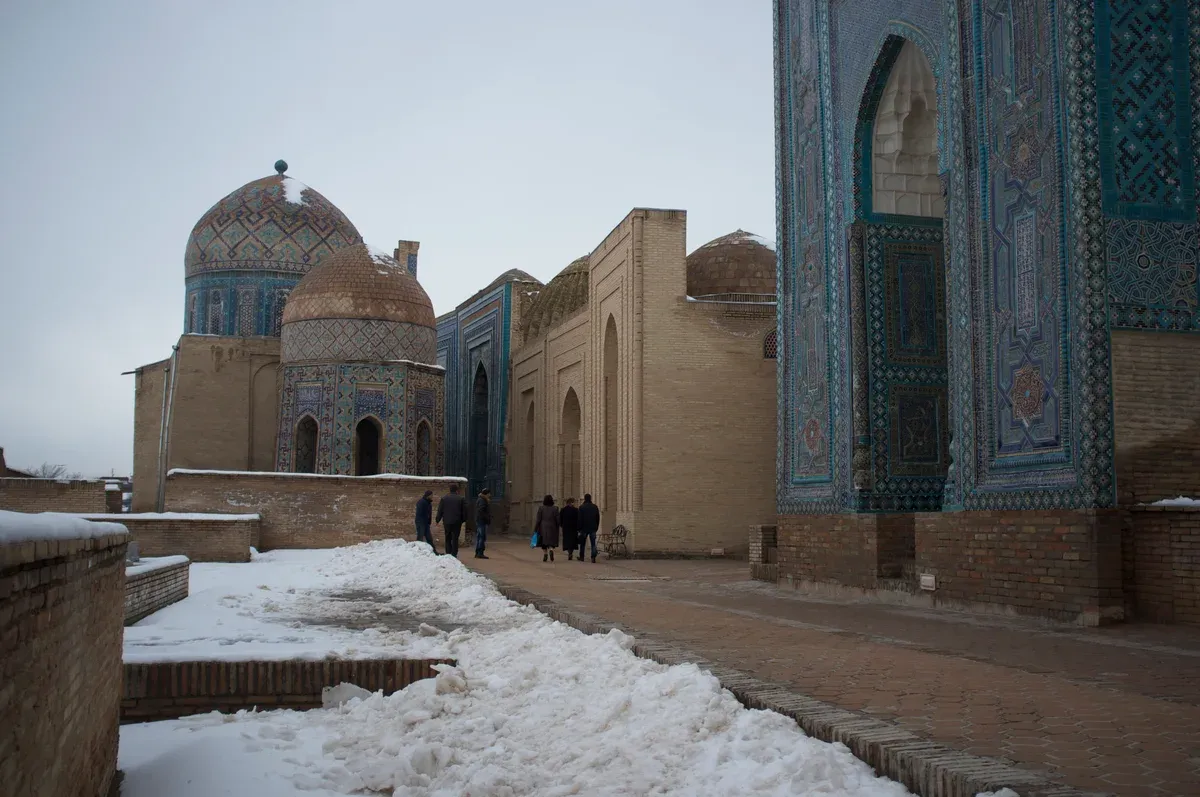
Shah-i-Zinda, Samarkand, in winter. Photo: Aleksandr Zykov from Russia, CC BY-SA 2.0, via Wikimedia Commons
Tours That Fit
These multi-day Silk Road tours cover the classic cities in the spring and autumn windows.
 from $1,234.39
Editor's pick
Magic Land 9-Day Uzbekistan Tour
Nine days from Tashkent to Bukhara, Samarkand and Shakhrisabz with the Afrosiyob train, monument tickets and visa support in the price.
Check Availability from $1,230.77
Uzbekistan Silk Road 8-Day Tour by Train
Eight private days through Khiva, Bukhara and Samarkand by train with monument tickets included. All sales are final.
Check Availability from $800
Uzbekistan 6-Day Private Tour with Khiva
Six private days with Khiva, trains and 3-star or boutique hotels. The Tashkent-Urgench flight and museum tickets are extra.
Check AvailabilityWhen is the Silk and Spices Festival?
The Silk and Spices Festival in Bukhara runs in May, the same month as the Boysun Bahori Festival.
Festivals can decide your travel month. Match them to the season you already prefer.
The festival calendar
Navruz falls on 21 March with music, dance and communal feasts. May brings two events, the Silk and Spices Festival in Bukhara and the Boysun Bahori Festival. August is the food month, with the Khiva melon festival and the Samarkand Plov Festival, and Stihia is also an August event. The UzChess Cup runs every June in Tashkent, and Independence Day on 1 September brings fireworks to the capital.
Marathons happen four times a year, so runners can pair a race with a city break in most seasons. Book rooms early if your dates fall on a festival.
| Month | Event | Where |
|---|---|---|
| March | Navruz, 21 March | Nationwide |
| May | Silk and Spices Festival | Bukhara |
| May | Boysun Bahori Festival | Boysun |
| June | UzChess Cup | Tashkent |
| August | Khiva melon festival | Khiva |
| August | Samarkand Plov Festival | Samarkand |
| September | Independence Day, 1 September | Tashkent, Alisher Navoiy National Park |
How do regional climate differences change my Silk Road route?
The far north and the far south swing harder than the classic cities, so match each region to its season.
Uzbekistan is big enough that one month is not right for every corner of it.
North, south, east and centre
Karakalpakstan in the northwest can fall to -40°C in winter. Termez in the south is the hottest town in the country. Near Tashkent, the ski season runs December to March in the Tien Shan Mountains, just under 100 km from the capital, and Tashkent air pollution is high in winter.
The classic Silk Road cities sit between those extremes. Samarkand and Bukhara are at their best from April to June and in September. Across the country, the cold month can drop below -6°C and the hottest month passes 32°C, with heat peaking from late June to early August.
March rain and mountain legs
March is the rainiest month of the year, and the rain falls hardest in the mountainous regions. A March trip works best on a city route through Tashkent and Samarkand. Save mountain legs, such as the Seven Lakes in Tajikistan, for the drier months.
Source: Uzbekistan Tourism.
Which Silk Road itinerary fits each season?
April and May suit the classic Khiva, Bukhara and Samarkand route, and September and October suit desert yurt nights plus the three cities.
Each season is paired with a concrete route choice.
Season and route pairings
Desert treks run March to May and September to October, so a yurt camp night belongs in those windows. The 2-Day Aydarkul Lake and Yurt Camp Tour costs $179 per person for 2 days, with transfers, guide, a yurt night, three meals and a short camel ride included, and lunch by the lake with a chance to swim if the weather allows. Rafting and kayaking around Tashkent peak in September and October, which pairs with a route that starts and ends in the capital.
For the full three-city route without the heat, April for Khiva and Bukhara or October for the whole run are the strongest choices.
| Season | Best route | Why |
|---|---|---|
| March | Tashkent and Samarkand city focus | Navruz on 21 March, but the rainiest month of the year |
| April to May | Classic Khiva, Bukhara, Samarkand circuit | Desert trek season, Bukhara festivals in May |
| June | Uzbekistan plus a Kyrgyzstan yurt camp extension | Kyrgyz yurt camps open in June |
| July to August | Short city stays with early starts | Bukhara above 40°C, heat peaks late June to early August |
| September to October | Aydarkul yurt camp plus the three cities | Desert treks run again, harvest markets are full |
| December to March | Tien Shan ski bases near Tashkent | Ski season, just under 100 km from the capital |
Choosing a ready-made tour
Ready-made routes cover the classic cities at different lengths. The Uzbekistan 6-Day Private Tour with Khiva is the shortest at $800 per person. It adds $275 in extra charges on top of the $800 base price, and the Tashkent-Urgench flight is not included.
The Uzbekistan Silk Road 8-Day Tour by Train costs $1,230.77 per person, with all train tickets, monument tickets and hotels included, air tickets extra and no refunds. The Magic Land 9-Day Uzbekistan Tour costs $1,234.39 per person with free cancellation up to 24 hours ahead. All three are rated 4.9.
What is the worst time to visit Uzbekistan?
July and August are the worst months for most travellers, when Bukhara regularly climbs above 40°C.
The worst time depends on your route, but heat is the main problem on the Silk Road circuit.
Heat, rain and deep cold
July heat in Bukhara and the desert areas often passes 40°C (104°F). The heat peaks from late June to early August, so pack sunscreen, sunglasses and a hat. Sightseeing then means early starts and a long midday break. August keeps the heat and adds the food festivals, which suit heat-tolerant travellers.
The other hard window is deep winter in the north. January lows reach -5°C (23°F) in the north and Karakalpakstan can fall to -40°C. The cold peaks from mid-December to late January. Winter still works for city breaks with clear skies and for skiing.
Source: Uzbekistan Tourism.
What is the cheapest time to visit Uzbekistan?
Winter is the cheapest season, with cheaper flights and the chance to negotiate lower hotel rates in February.
Price and comfort run in opposite directions here.
How to pay less
Winter brings cheaper flights, and in February you may be able to negotiate lower hotel rates. The trade-off is the weather. The cold month can drop below -6°C, and desert treks run only March to May and September to October.
City walks run year round at low prices. The Samarkand Historical Monuments Walking Tour costs $15 per person for 4-4.5 hours, entrance fees paid at each site, and the Bukhara Old City Small-Group Walking Tour costs $18 per person for 3.5-4 hours. The Bukhara walk runs with 2 to 8 people in late autumn and winter, against 3 to 10 from spring to autumn.
Source: Uzbekistan Tourism.
When should I go if combining Uzbekistan with Kyrgyzstan or Tajikistan?
Aim for June if Kyrgyzstan is on the route, when its yurt camps open, and sort a multi-entry visa before any overland crossing.
Multi-country Silk Road trips need the season and the paperwork to line up.
Making the borders line up
One specialist operator recommends October for an Uzbekistan-only trip, or June when combining it with Kyrgyzstan's yurt camps. If your trip crosses into neighbouring countries by train or road, Canada advises a multi-entry visa for Uzbekistan plus any visa the other country requires. The foreign ministry lists the multiple-entry e-visa at $50 and the single-entry e-visa at $20.
Tajikistan is closest from Samarkand. The Seven Lakes Day Trip from Samarkand costs $82 per person for 11-12.5 hours, with transfers, guide and a lakeside lunch included and the Tajik visa extra where needed. Avoid March for mountain border legs, the rainiest month of the year.
Sources: Government of Canada, Uzbekistan MFA.
Is winter a good time to visit Uzbekistan?
Winter suits city breaks and skiing, with clear skies and cheaper flights, but not desert nights or Karakalpakstan.
Winter runs from November to March, and it splits travellers into two camps.
What winter gives and takes
Winter brings clear skies and cheaper flights, and in February you may be able to negotiate lower hotel rates. Skiing in the Tien Shan Mountains, just under 100 km from Tashkent, runs December to March, and December to January is the best stretch for it.
The cost is the cold. January averages -8 to +3°C, the cold peaks from mid-December to late January, and Karakalpakstan can fall to -40°C. Tashkent air pollution is high in winter. Desert treks pause until March.
Source: Uzbekistan Tourism.
What timing tips matter most on the Silk Road circuit?
Start early on hot days, dress for religious sites in every season, and book rooms early around festivals.
A few habits make the circuit easier in any month.
Practical timing rules
In the heat, plan the outdoor hours around the ends of the day. The Samarkand Historical Monuments Walking Tour runs 4-4.5 hours and finishes with 1 hour at Shah-i-Zinda at sunset. The Afrosiyob high-speed train covers the 344 km from Tashkent to Samarkand in two hours fifteen minutes, so a day trip from the capital loses little time on the road.
Dress for the buildings, not the weather. At Samarkand religious sites, including the Registan and Gur-e-Amir, women should cover shoulders, back and legs. Mosque visitors dress modestly, women cover their heads, and visits happen when no worship is taking place. Carry a scarf and long layers even in July.
Source: Uzbekistan Railways.
Frequently Asked Questions
What is the best month to visit Uzbekistan?
April and May give the best comfort and landscape colours, and late September to October is harvest time with full markets. Compare Silk Road tours to fix your dates.
How many days in Uzbekistan is enough?
Multi-day routes run 6 to 9 days. The Uzbekistan 6-Day Private Tour with Khiva costs $800 per person and adds $275 in extra charges plus the Tashkent-Urgench flight. The Magic Land 9-Day Uzbekistan Tour costs $1,234.39 per person.
Is it safe for US citizens to travel to Uzbekistan?
Canada advises normal security precautions nationwide except within 5 km of the Afghan border, far from the Silk Road cities. In season, the main risks are July heat and deep winter cold in the north. See the worst time to visit.
Can a woman wear shorts in Uzbekistan?
Not at religious sites. At Samarkand religious sites women should cover shoulders, back and legs, and women cover their heads in mosques, so pack long layers in every month. More in the timing tips.
Is September a good month to visit?
Yes. September brings 14°C (57°F) to 30°C (86°F), desert treks run again, rafting around Tashkent is at its best, and Independence Day on 1 September adds fireworks. The Aydarkul yurt camp tour fits this window.
When is the best time to visit Uzbekistan for snow or skiing?
December to January is best for skiing, and the season runs December to March in the Tien Shan Mountains, just under 100 km from Tashkent. See winter in Uzbekistan.
When should I visit from the USA?
The best months are the same wherever you fly from: March to mid-June or September to October. Travellers who need a visa apply before arrival, and a single-entry e-visa costs $20. Read the month table to pick dates.
How does March rain affect travel plans?
March is the rainiest month of the year, especially in mountainous regions, so favour a city route and save mountain legs for drier months. Navruz on 21 March is the reason to go. See regional differences.
More Guides
- Which Silk Road Cities Can You Visit on a Tour of Uzbekistan?
Silk Road cities in Uzbekistan for 2027: Samarkand, Bukhara, Khiva and Tashkent on 6 to 9 day routes. See what each holds and plan your tour.
- Bukhara Tours: Old City Walks with a Local Guide
Compare Bukhara tours for 2027: a 3.5 to 4 hour small-group walk and a 6 hour private tour, with routes, meeting points and what costs extra.
- Day Trips from Samarkand: Seven Lakes and a Yurt Camp
Plan day trips from Samarkand in 2027: the Seven Lakes at 2,200 m, an 88 km run to Shahrisabz and a yurt camp. Compare two tours and book.