 Silk Road Tours
Home › Guides › Which Silk Road Cities Can You Visit on a Tour of Uzbekistan?
Which Silk Road Cities Can You Visit on a Tour of Uzbekistan?
The Silk Road was never one road, and the Silk Road cities a tour of Uzbekistan actually visits are Tashkent, Samarkand, Bukhara and Khiva, linked in 6 to 9 days. This guide separates the myths from the facts, shows what each city holds, and explains how the tours string the cities together.
Quick answer Four cities, one route, 6 to 9 days
Five of the nine best Silk Road cities to visit today are in Uzbekistan: Samarkand, Bukhara, Khiva, Tashkent and Fergana. Tours link the first four in 6 to 9 days, starting in Tashkent. Samarkand, Bukhara and Khiva are each listed by UNESCO in their own right.
Key takeaways
- The classic route by rail: Uzbekistan Silk Road 8-Day Tour by Train covers Khiva, Bukhara and Samarkand.
- Samarkand is the city every route is built around: compare the Samarkand tours.
- Bukhara and Khiva each have their own walks: see Bukhara tours and Khiva tours.
- All multi-day routes side by side: Silk Road tours in Uzbekistan.
Does the Actual Silk Road Still Exist?
No, the Silk Road was a network of trade routes that faded in the 15th century, and what you visit today are the cities that grew rich on it.
The most common myth is a single road you could still drive from China to Europe.
A Network, Not a Road
The Silk Road ran from the Mediterranean basin in the west to the Korean peninsula and the Japanese archipelago in the east. Its main eastern end was Chang'an, modern Xi'an in China. Its main western end was Antioch, modern Antakya in Turkey. The overland caravan routes covered between 6,400 and 10,000 kilometers and crossed more than 40 modern countries. Sea routes ran alongside them, also called the spice routes.
The network came into existence in the 2nd century BCE. It lasted until the 15th century CE, when the Ottoman Empire blocked the trade routes after capturing Constantinople.
Even the Name Is Modern
Nobody on the caravans called it the Silk Road. The German geologist Baron Ferdinand von Richthofen named the network Die Seidenstrasse, first in his book China in 1877. What survives is the cities: hubs of culture and learning where science, arts, literature, crafts and technologies were shared.
In Uzbekistan those cities still stand, and a tour moves between them by train and car rather than by caravan.
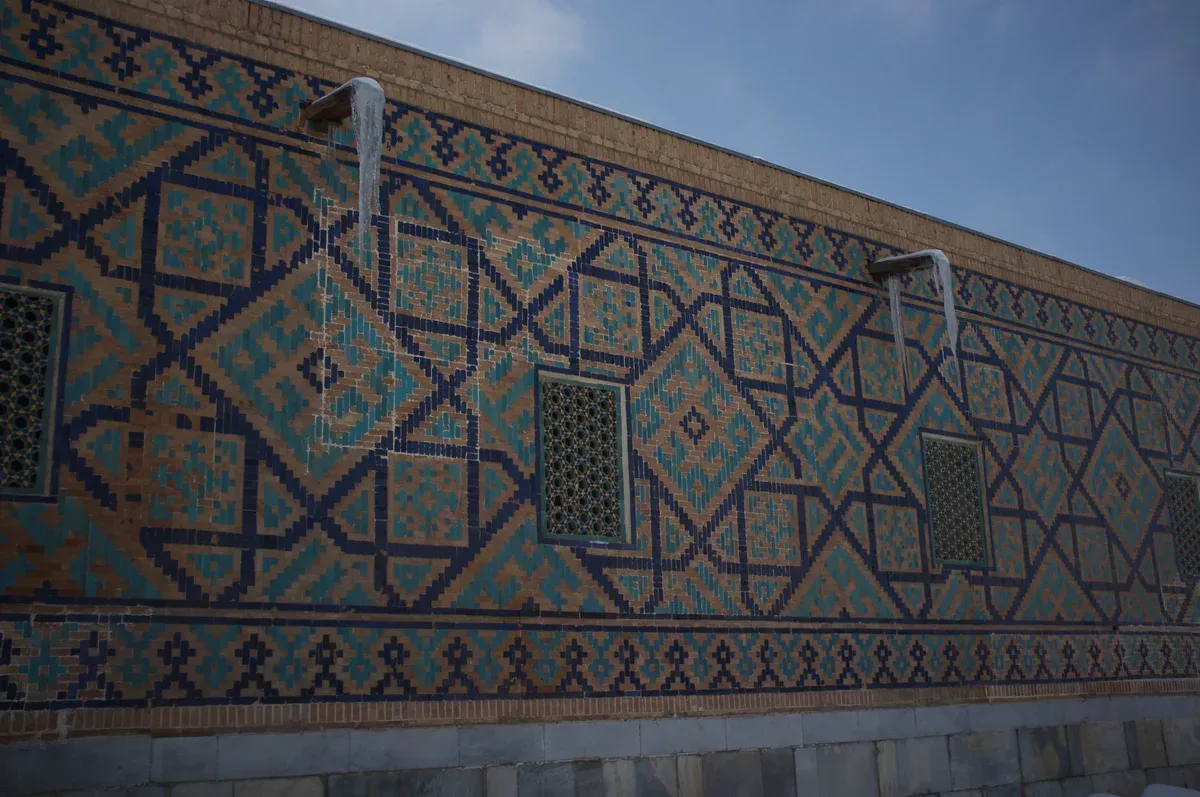
Tilework on the Registan, Samarkand. Photo: Aleksandr Zykov from Russia, CC BY-SA 2.0, via Wikimedia Commons
What Are the Three Major Cities of the Silk Road?
Ranked lists differ, but Xi'an and Samarkand appear at the top of the historic mega cities, and on an Uzbekistan tour the three major cities are Samarkand, Bukhara and Khiva.
The answer changes depending on whether you mean the historic giants or the cities you can walk through today.
The Historic Giants
One ranking of the five mega cities of the Silk Road names Xi'an, Samarkand, Aleppo, Mosul and Merv. Xi'an, then Chang'an, was the main eastern end, and Sogdian merchants from Central Asia were vital agents in carrying and trading goods there. Samarkand is the only one of the five inside Uzbekistan.
The myth to drop is that the great cities were all in China or the Middle East. Central Asia sat in the middle of the trade, and Samarkand thrived as Tamerlane's capital from the end of the 14th century.
The Three You Visit
For a traveller, the three major Silk Road cities are Samarkand, Bukhara and Khiva. Each carries its own UNESCO listing, and each is a stop on the Uzbekistan Silk Road 8-Day Tour by Train at $1,230.77 per person. Tashkent is the arrival city that ties them together.
Source: UNESCO.
Which Uzbek Cities Can I Visit on a Silk Road Tour?
Tours visit Tashkent, Samarkand, Bukhara and Khiva, and some add Shakhrisabz, while Fergana is on the list of great Silk Road cities but off the usual tour routes.
Five of the nine best Silk Road cities on one operator's ranked list are Uzbek. The table shows what each holds and which tours stop there.
The Cities at a Glance
The table compares the Uzbek Silk Road cities on what you see there, their UNESCO listing and which multi-day tours on this site include them. UNESCO years come from UNESCO's own list of Uzbek World Heritage sites, and the tour stops come from each tour's listing.
| City | What you see | UNESCO listing | Tours that stop |
|---|---|---|---|
| Samarkand | Registan Square, Shah-i-Zinda necropolis, Ulugh Beg Observatory | Samarkand, Crossroad of Cultures, inscribed 2001 | All three multi-day tours |
| Bukhara | Narrow alleys, caravanserais and mosques | Historic Centre of Bukhara, inscribed 1993 | All three multi-day tours |
| Khiva | Ichan Kala inside its walls | Ichan Kala, inscribed 1990, the first in Uzbekistan | 8-Day Tour by Train, 6-Day Private Tour with Khiva |
| Shakhrisabz | Historic centre | Historic Centre of Shakhrisabz, inscribed 2000 | Magic Land 9-Day Uzbekistan Tour |
| Tashkent | Arrival city and rail hub | None | Start city of all three |
| Fergana | Ranked among the best Silk Road cities | None | None of the tours here |
What the Table Means for a Route
Samarkand and Bukhara are on every multi-day route. Khiva is the one that splits the tours: the Magic Land 9-Day Uzbekistan Tour at $1,234.39 per person leaves it out and adds Shakhrisabz instead. Fergana is a separate trip altogether.
If Khiva matters to you, read the itinerary before you book.
Source: UNESCO.
What Is There to See in Samarkand?
Samarkand's key sights are Registan Square, the Shah-i-Zinda necropolis and the Ulugh Beg Observatory, founded in 1424.
Samarkand is the center of almost every Silk Road tour of Uzbekistan.
Tamerlane's Capital
Samarkand thrived under Tamerlane, who made it his capital at the end of the 14th century. Ulugh Beg founded one of the greatest observatories there in 1424. The highlights a tour covers are Registan Square, the Shah-i-Zinda necropolis and the Ulugh Beg Observatory.
In Samarkand you can join a guided walk through the Registan and Shah-i-Zinda, compared on the Samarkand tours page. With one free day in Tashkent, the Samarkand day trip from Tashkent covers the same monuments by high-speed train. From Samarkand, day trips reach the Seven Lakes in Tajikistan and Aydarkul Lake.
Tours That Fit
Three multi-day routes that link the Uzbek Silk Road cities from Tashkent.
 from $1,230.77
Uzbekistan Silk Road 8-Day Tour by Train
Eight private days through Khiva, Bukhara and Samarkand by train with monument tickets included. All sales are final.
Check Availability from $800
Uzbekistan 6-Day Private Tour with Khiva
Six private days with Khiva, trains and 3-star or boutique hotels. The Tashkent-Urgench flight and museum tickets are extra.
Check Availability from $1,234.39
Editor's pick
Magic Land 9-Day Uzbekistan Tour
Nine days from Tashkent to Bukhara, Samarkand and Shakhrisabz with the Afrosiyob train, monument tickets and visa support in the price.
Check AvailabilityAre Bukhara and Khiva Worth Adding to a Silk Road Tour?
Yes, Bukhara and Khiva are both UNESCO-listed old towns, but Khiva costs extra travel time and sometimes a separate flight.
Bukhara is on every route. Khiva is the city that changes the length and the price.
Bukhara
The Historic Centre of Bukhara was inscribed by UNESCO in 1993. It is a city of narrow alleys, ancient caravanserais and mosques, best seen on foot. All three multi-day tours here stop in Bukhara, and short guided walks of the old city are compared on the Bukhara tours page.
Khiva
Ichan Kala in Khiva was inscribed in 1990 and is Uzbekistan's first World Heritage site. Reaching it is the catch. The Uzbekistan 6-Day Private Tour with Khiva costs $800 per person, and the listing adds $275 in extra charges on top of that base price.
The Tashkent-Urgench flight is not included, and the trains back from Khiva through Bukhara and Samarkand to Tashkent are. The Uzbekistan Silk Road 8-Day Tour by Train at $1,230.77 per person includes all its train tickets. For walks inside the walls and the desert fortresses, see the Khiva tours.
Source: UNESCO.
How Do the Silk Road Cities in Uzbekistan Connect on One Route?
Every multi-day tour starts in Tashkent and links Samarkand and Bukhara by train, and the routes differ on whether they add Khiva or Shakhrisabz.
The order of the cities decides the length of the trip and what the price covers.
Three Routes Compared
The table compares the three multi-day Silk Road tours on price, length, the cities they visit and how they move between them. The figures come from each tour's own listing.
| Tour | Price | Length | Cities | How you travel |
|---|---|---|---|---|
| Uzbekistan 6-Day Private Tour with Khiva | $800 per person, plus $275 in listed extra charges | 6 days | Tashkent, Khiva, Bukhara, Samarkand | Train Khiva-Bukhara-Samarkand-Tashkent included, Tashkent-Urgench flight not included |
| Uzbekistan Silk Road 8-Day Tour by Train | $1,230.77 per person | 8 days | Khiva, Bukhara, Samarkand | All train tickets included, air tickets extra |
| Magic Land 9-Day Uzbekistan Tour | $1,234.39 per person | 9 days | Tashkent, Samarkand, Bukhara, Shakhrisabz | Afrosiyob high-speed train Samarkand-Tashkent included |
Leaving the Circuit
The 8-day tour has no refunds, while the 6-day and 9-day tours allow free cancellation up to 24 hours ahead. Some travellers extend the route across a border, for example to the Seven Lakes in Tajikistan from Samarkand. If a trip crosses into neighbouring countries by train or road, Canada advises a multi-entry visa for Uzbekistan plus any visa the other country requires.
For the train links themselves, read how to travel the Silk Road in Uzbekistan by train.
Source: Government of Canada.
Is the Silk Road in Uzbekistan a UNESCO World Heritage Site?
The Uzbek cities are listed one by one, while the Silk Roads corridor through Uzbekistan is a separate nomination and not yet the listed corridor.
Another common belief is that the whole Silk Road is one UNESCO listing that includes Uzbekistan.
Two Corridors, Two Stories
The Silk Roads Chang'an-Tianshan Corridor was presented by China, Kazakhstan and Kyrgyzstan in 2014. Uzbekistan is not part of it. A separate Silk Roads corridor, Zarafshan-Karakum, was nominated by Tajikistan, Turkmenistan and Uzbekistan, with about 15 Uzbek sites in the dossier.
The Uzbek cities do not need the corridor to be on the list. Ichan Kala in Khiva was inscribed in 1990, the Historic Centre of Bukhara in 1993, the Historic Centre of Shakhrisabz in 2000 and Samarkand, Crossroad of Cultures in 2001.
Source: UNESCO.
Is It Hard to Enter Uzbekistan for a Silk Road Tour?
No, UK citizens can visit Uzbekistan without a visa for up to 30 days, though cash needs some planning.
The last myth is that the Silk Road cities sit behind a hard visa process.
Entry and Money
UK citizens can visit Uzbekistan without a visa for tourism or business for up to 30 days. Check your own nationality in the Uzbekistan visa guide before you book.
Money is the bigger planning point. The UK government says the som cannot be obtained outside Uzbekistan and ATMs are scarce outside major cities. Black-market exchange is illegal, and official booths reject US dollars issued before 2013. Change cash in Tashkent before you leave for Khiva or the smaller stops.
Source: UK Foreign Office.
When Did the Silk Road Begin?
The network came into existence in the 2nd century BCE, after the Chinese envoy Zhang Qian reached Bactria in 128-127 BC.
A little history explains why the Uzbek cities matter so much.
From Zhang Qian to the Ottomans
In 128-127 BC the Chinese ambassador Zhang Qian travelled to Bactria, which helped the Han Empire open trade relations with Central Asia. The cities along the routes became hubs of culture and learning where science, arts, literature, crafts and technologies were shared. Sogdian merchants from Central Asia were vital agents in that trade all the way to Chang'an.
The network lasted until the 15th century CE, when the Ottoman Empire blocked the trade routes after capturing Constantinople. Samarkand's great age under Tamerlane came near the end of that span, at the end of the 14th century. That is why its monuments are the grandest stop on the Silk Road tours in Uzbekistan.
Silk Road Cities: FAQ
What city was along the Silk Road?
Many were, from Chang'an (Xi'an) in the east to Antioch in the west. In Uzbekistan the best known are Samarkand, Bukhara and Khiva, all three on the Uzbekistan Silk Road 8-Day Tour by Train.
What were three important cities along the Silk Road?
Xi'an, Samarkand and Merv all rank among the great mega cities of the network. Of the three, only Samarkand is in Uzbekistan: see the Samarkand tours.
How many days do you need for the Silk Road cities of Uzbekistan?
The multi-day tours run 6, 8 or 9 days. The Uzbekistan 6-Day Private Tour with Khiva is the shortest route that still reaches Khiva.
Can you travel between the Silk Road cities by train?
Yes. The tours move between Tashkent, Samarkand, Bukhara and Khiva by train. Read how to travel the Silk Road in Uzbekistan by train.
Which Silk Road city should you not skip in Uzbekistan?
Samarkand. All three multi-day tours stop there, and it holds the Registan and Shah-i-Zinda. One free day? Take the Samarkand day trip from Tashkent.
When is the best time to visit the Silk Road cities?
Spring and autumn are the most comfortable months for sightseeing in Uzbekistan. See the best time to visit Uzbekistan.
More Guides
- Samarkand Tours: Guided Walks Through the Registan and Shah-i-Zinda
Samarkand tours for 2027: two guided walks of 4-4.5 hours through the Registan and Shah-i-Zinda. Compare routes and meeting points, then book.
- Bukhara Tours: Old City Walks with a Local Guide
Compare Bukhara tours for 2027: a 3.5 to 4 hour small-group walk and a 6 hour private tour, with routes, meeting points and what costs extra.
- Khiva Tours: Ichan Kala and the Desert Fortresses
Compare Khiva tours in 2027: a 4-hour Ichan Kala walk, a 6-hour desert fortress trip and a 9-hour route to Bukhara, with what each price leaves out.